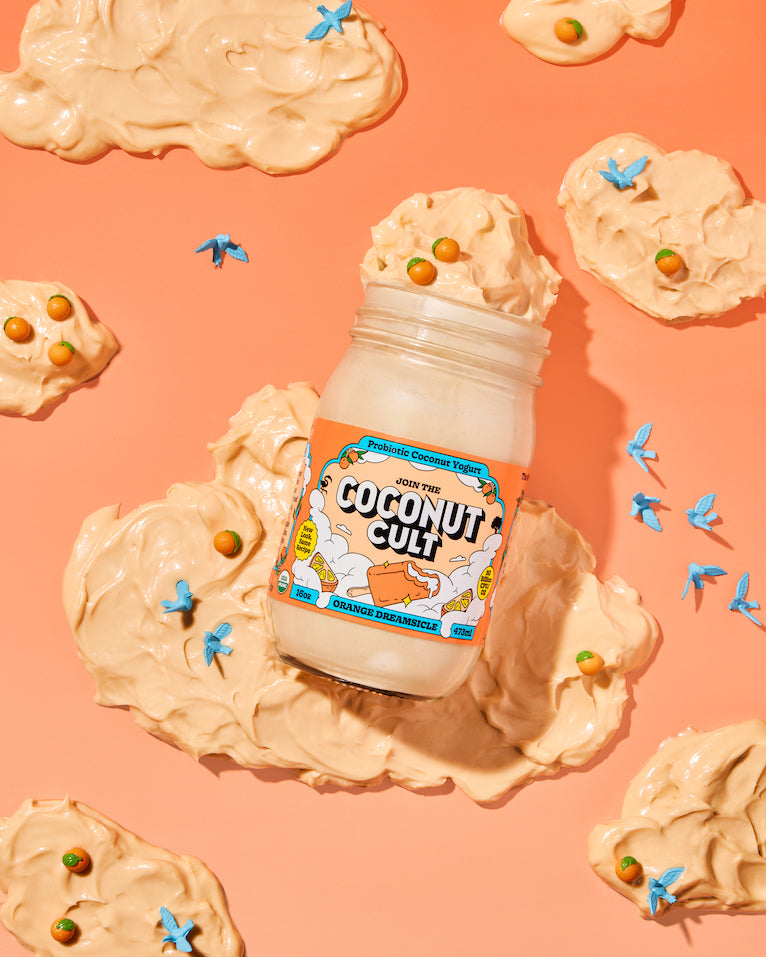

Inside the Cult

Yes! Probiotic coconut yogurt can be incredibly healthy. However, not all yogurts are created equal. The difference between them comes down to ingredients, variety of cultures, and whether those cultures are actually alive when they reach you.
The Nutritional Profile
Using Coconut Cult Original as the benchmark, here’s what you get in a 2 fl oz serving:
-
120 calories
-
9g fat (8g saturated, from coconut MCTs)
-
4g carbohydrates (2g fiber, 2g natural sugar, 0g added sugar)
-
2g protein
-
236mg potassium
-
10mg sodium
Four ingredients: Organic Coconut Cream, Organic Coconut Meat, Organic Coconut Water, Custom Probiotic Cultures.
That’s it. No gums, no thickeners, no “natural flavors,” no refined sugar. USDA Organic certified, Fair Trade coconut sourced from Thailand.
The zero grams of added sugar is significant. Most yogurts — dairy and plant-based alike contain 10–20g of added sugar per serving. Coconut Cult Original has none. The 2g of natural sugar comes entirely from the coconut itself.
What About the Saturated Fat?
Yes, 8g per serving. Context matters: coconut cream is rich in medium-chain triglycerides (MCTs) — a type of saturated fat metabolized fundamentally differently than long-chain fats found in animal products. MCTs are absorbed rapidly, transported directly to the liver, and converted to energy rather than stored as body fat in the traditional sense. Research on MCTs also links them to improved satiety and metabolic support. You’ll stay full longer on two spoonfuls than you’d expect.
Are They Actually Alive?
This is the whole game. And here’s the uncomfortable truth about most commercial yogurt: it’s pasteurized after fermentation, which means the live bacteria — the entire reason you’re eating yogurt for gut health — are killed by heat before the product ever sees a shelf. Dead cultures do nothing for your microbiome.
Harvard Health confirms that live probiotics may help improve immune function, protect against harmful bacteria, improve digestion, and offset bacterial imbalances caused by antibiotics. Key word: live.
Coconut Cult is never pasteurized after fermentation. Every jar contains 16 super-live probiotic strains — including L. rhamnosus, L. acidophilus, B. longum, B. bifidum, L. reuteri, and 11 more — delivering 50 billion CFU per ounce, or 100 billion CFU per 2 fl oz serving at time of bottling. That tangy, effervescent taste you notice? That’s live fermentation. That’s proof.
“If your yogurt isn’t alive, your gut can’t thrive.”
Coconut also acts as a natural prebiotic: a dietary fiber that feeds the beneficial bacteria in your gut. This makes Coconut Cult a true synbiotic: delivering both the probiotics and the food that sustains them in every single spoonful. As our FAQ explains: “We are technically considered a synbiotic, meaning that our yogurt is both a prebiotic and a probiotic.”
Coconut Cult Yogurt vs. Dairy Yogurt
|
Factor |
Coconut Cult |
Most Dairy Yogurt |
|
Live probiotics |
✅ 100B CFU, never pasteurized after fermentation |
❌ Usually pasteurized = dead cultures |
|
Added sugar |
✅ 0g |
❌ Often 10–20g |
|
Prebiotic fiber |
✅ From coconut base |
❌ None |
|
Dairy-free |
✅ |
❌ |
|
Protein |
⚠️ 2g per serving (depends on flavor) |
✅ 15–20g (Greek yogurt) |
Who Is Coconut Cult Yogurt For?
✅ Vegan — 100% plant-based (check collab flavors individually)
✅ Dairy-Free — No milk, whey, casein, or lactose
✅ Soy-Free — No soy ingredients
✅ Gluten-Free — No gluten-containing ingredients
✅ Keto-Friendly — 2g net carbs, 0g added sugar, high MCT fat
✅ Paleo — Whole food ingredients, fermented traditionally
✅ Nut-Free — Coconut is no longer classified as a major allergen (as of Jan 1, 2025)
For the most current allergen and dietary information, always check our FAQ page.
Building Your Daily Ritual
Start with two - four spoonfuls (1-2 fl oz) per day. Morning with breakfast or as an after-dinner snack are both excellent. You can eat it on an empty stomach or with food, either gets the live bacteria to your digestive system.
✨ Give your gut life ✨
Shop all flavors or find a store near you to start your ritual.
