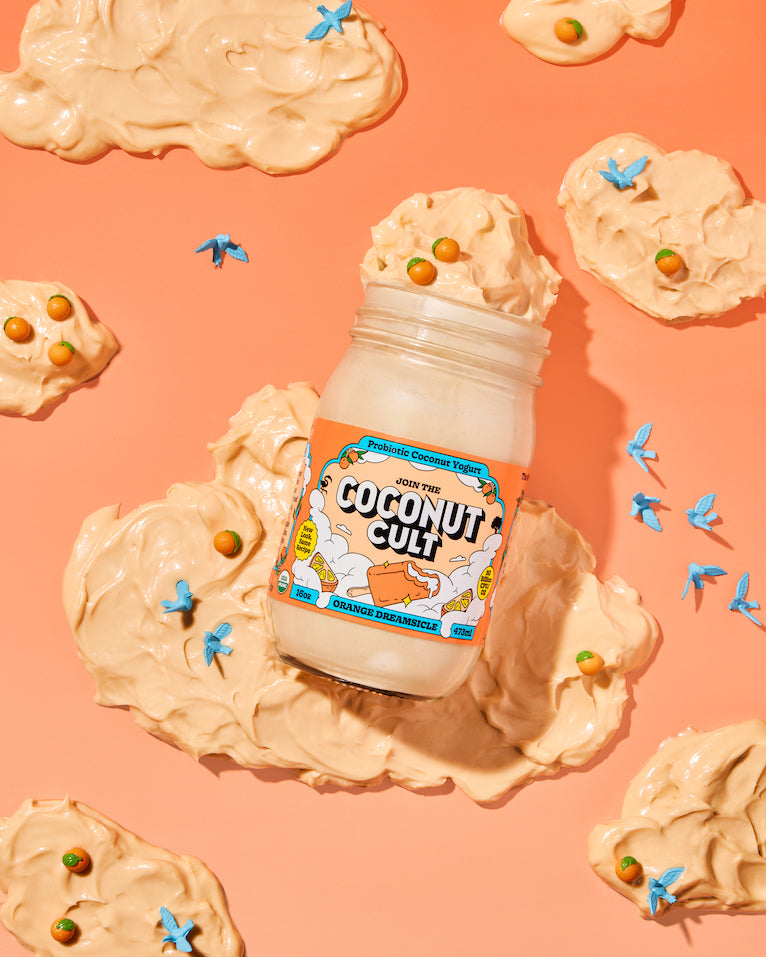


Meet the Original Cult Leader
Before there was Coconut Cult, there was Noah, a kitchen, and a growing obsession with fermentation.
In his late twenties, our founder, Noah, became deeply interested in fermented foods, cultures, and the role they could play in his own wellness routine. That curiosity eventually led him to start making homemade coconut yogurt using a culture blend he had spent a lot of time experimenting with and perfecting.
He started sharing his creations with friends and family too. Soon, demand for Noah’s delicious homemade coconut yogurt kept growing, and he eventually convinced his best friends to join him in starting Coconut Cult. 🌴 🥥 🦩
You can hear Noah tell more of his story in his own words here. That homemade yogurt experiment became the starting point for Coconut Cult.
The jars look a little more official these days, but the obsession with quality coconut yogurt and fermentation? Very much still alive and well.
So, what are probiotics exactly and why are we so obssesed?
According to the National Center for Complementary and Integrative Health, probiotics are live microorganisms that are intended to have health benefits when consumed or applied to the body.
The National Institutes of Health notes that different probiotic microorganisms can have different characteristics and that potential effects may depend on the specific organism being studied.
Research on probiotics is constantly developing and is often specific to the particular microorganism being studied, how much is consumed, and the context in which it’s used.
In other words, there’s no one-size-fits-all probiotic story.
Not every microorganism, fermented food, or culture automatically qualifies as a probiotic. Fermented foods can still have their own unique qualities; they’re just not automatically “probiotic.”
What does that have to do with Coconut Cult?
Fermentation is at the heart of how we make our coconut yogurt. We start with coconut cream, coconut meat, coconut water, and our signature culture blend of 16 strains:
-
L. lactis
-
S. thermophilus
-
L. salivarius
-
L. acidophilus
-
L. helveticus
-
L. plantarum
-
L. gasseri
-
L. brevis
-
L. casei
-
L. fermentum
-
L. reuteri
-
L. rhamnosus
-
B. longum
-
B. infantis
-
B. breve
-
B. bifidum
Then give the whole thing time to ferment and become the tangy creation we’re obsessed with. We also don’t use gums or fillers to force every batch into the exact same texture, so you may notice natural variation from batch to batch.
Some are extra fluffy, some have more coconut liquid, and some bring a little extra fizz.
✨ Welcome to the world of fermented foods. ✨
What’s the best way to eat Coconut Cult?
First things first, get your favorite spoon. 🥄
Some Culties eat their Coconut Cult straight from the jar. Others add it to berries, granola, smoothies, pancakes, snack bowls, or whatever else is currently happening in their fridge.
If Coconut Cult is new to you, we recommend starting with 2–4 tablespoons and increasing gradually based on your preference and tolerance.
There is, however, one sacred rule in this Cult:
NO DOUBLE DIPPING. ✋🛑
Putting a used spoon back into the jar can introduce bacteria and food particles that may affect the freshness of your yogurt. Always use a clean spoon, keep the jar refrigerated, and close it back up when you’re done.
Once opened, we recommend enjoying your Coconut Cult within 2 - 3 weeks, as long as it has been continuously refrigerated and handled with a clean spoon.
Keep it cold. Keep it clean. Keep your spoon to yourself. 🥥
Still culty after all these years
What started with Noah making fermented coconut yogurt in his kitchen turned into a full-blown Cult — and we’re still just as obsessed.
Still curious.
Still devoted.
Still making coconut yogurt with way too much personality.
And still religious about probiotics. 🕯️🥥
Ready to join the Cult? Shop all Coconut Cult and find your next favorite jar.
